Dice Yatzy - Classic Fun Game
- 4.8
- Rating
- 1.00M
- Installs
- Free
- Price

 Analysis by App-foxy
I found Dice Yatzy - Classic Fun Game to be the kind of board game that is easy to understand within a minute but still gives me enough room to think about every roll. It uses the familiar Yatzy-style idea of building combinations with dice, so I never had to learn a complicated ruleset before starting. That simplicity is its biggest advantage: I can open it for a short break, play with friends, or settle into several rounds when I want something more focused.
FunCraft Games presents it as a free dice game for everyone, and that description matches my first impression. The game is available for Android devices running Android 7.0 or later, and its age rating is Everyone. It has reached over a million installs, with an average rating of 4.8 from around 26 thousand ratings. Those figures suggest that the straightforward format has found a broad audience, although popularity alone does not make every session equally satisfying.
My overall view is positive, especially for people who like classic board games without a large amount of setup. The important question is not whether the rules are deep enough to compete with a strategy-heavy board game; they are not trying to be that. The better question is whether the dice decisions, visible progress, and social play create a pleasant reason to return. In my experience, they do, but the appeal depends heavily on how much variety and long-term progression you expect.
You May Also Like

 Blood Strike: 2.5 Anniversary
Blood Strike’s Loadouts Turn Every Drop Into a Tactical Gamble
A close look at Blood Strike’s custom loadouts: how fast access to signature weapons reshapes its battle royale rhythm, rewards preparation, and narrows the gap between fights.

 Pandora - Music & Podcasts
Pandora’s Music Is Easy to Start, but Harder to Recover
Pandora’s strength is its low-effort path from a seed to a station. Its weak spot is how much confidence it asks you to place in connection, setup, and quiet recovery.

 8 Ball Pool
 Is Built on Rivalries, Rematches, and Routine
A close look at the rivalries, rematches, shared routines, and unanswered safety questions that turn a quick pool match into a persistent mobile community.

 Samsung Music
’s Quiet Strength Is Playing What You Already Own
Its reach comes less from spectacle than from dependable access to a personal library. That simplicity is both the app’s strongest retention engine and its ceiling.

 AccuWeather: Weather Radar
AccuWeather Review: A Quick, Clear Forecast for Everyday Decisions
For everyday plans, the best forecast is the one you can understand quickly. AccuWeather makes rain timing, radar, and local conditions easy to act on, with a few trade-offs.

 Hill Climb Racing
Why Hill Climb Racing Still Turns Crashes Into One More Run
A tiny car, a bumpy hill and one more upgrade: Hill Climb Racing keeps resurfacing because its simple chaos makes every near-miss feel personal.
More From Our News Desk



What the first few games teach you
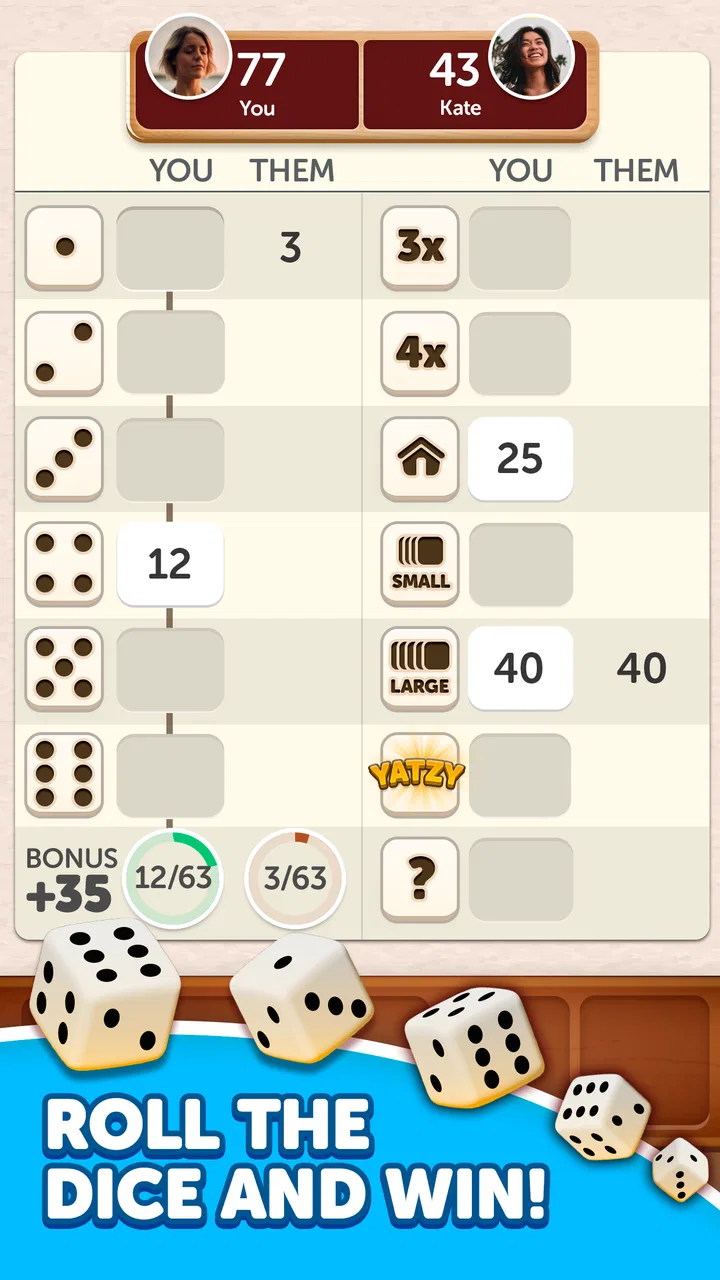
The early experience works because the objective is immediately readable. I roll dice, look at the combinations available, decide what to keep or chase, and place the result where it helps my score. That basic loop gives me an early goal without forcing me through a long tutorial. I can understand the value of a promising roll and the danger of wasting a turn before I have played many rounds.
That clarity matters when introducing the game to friends or family members who do not regularly play mobile games. I can explain the main idea while we are already playing instead of pausing to describe several menus, currencies, or character abilities. For a casual group, this makes the first session feel like a board game night rather than a lesson in a new app.
The first useful skill is learning not to chase every attractive combination. A roll that looks exciting may not be worth protecting if it leaves the rest of the score sheet in a difficult position. I found that the early games gently encourage this judgment: I begin by celebrating large combinations, then gradually notice that a modest, reliable score can be more valuable than a risky attempt at something spectacular.
This is also where the game’s early goals become personal. One player may focus on completing combinations, while another may care more about avoiding a poor entry on the score sheet. Because the dice introduce uncertainty, I cannot follow one perfect plan from beginning to end. I have to adapt to what appears, which keeps the familiar rules from feeling completely automatic.
For a quick everyday example, I could play a round while waiting for an appointment or during a short commute break, provided I am not the one driving. The game suits that situation because a single decision is understandable at a glance. I do not need to remember a complicated story or return to a large map after a few minutes away. If I have more time, I can continue into another round without the game becoming a major commitment.
Why the score sheet becomes the real tutorial
The score sheet is more important than it first appears. It turns each roll into a small planning problem, because every decision affects what remains possible later. I learned to look beyond the current dice and ask which categories I am closing off. That habit is a more meaningful early lesson than simply trying to maximize the number in front of me.
A practical tip is to treat weak rolls as information rather than immediate failure. If the dice do not support the combination I wanted, I can use the turn to protect a category that is becoming harder to fill. This reduces the frustration that comes from unlucky outcomes. The game remains chance-driven, but thoughtful category choices give me some control over how much that chance hurts.
Another useful approach is to decide my priority before the final roll. If I wait until the last moment to choose between a safe score and a risky combination, I am more likely to follow the excitement of the dice. Setting that intention early makes the game feel less random without pretending that skill can remove randomness.
Progress signals and the feeling of moving forward
Dice Yatzy - Classic Fun Game does not need a large adventure structure to communicate progress. The clearest signal is the score I build during a round and the way my decisions improve as I understand the categories. I can feel the difference between a first game, where I react to each roll, and a later game, where I plan around future opportunities.
That kind of progress is subtle. I am not necessarily unlocking a new world or changing a character. Instead, I am becoming better at reading risk, estimating what a roll can realistically produce, and accepting a useful result instead of waiting forever for a perfect one. Players who enjoy improving their own decisions may find this satisfying, while players who need frequent visible rewards may find it too restrained.
The game’s social setting adds another progress signal. Playing with friends gives each round a clear comparison point, and a familiar opponent can make small improvements feel meaningful. I may not remember every score, but I remember the turn where a risky choice worked or the moment I recovered from a bad start. That personal history helps the simple rules stay engaging.
Still, I would not describe the progression as a traditional unlock chase. The game is strongest when I want to improve at the core dice format, not when I am looking for a steady stream of new content. This distinction is important before downloading it. Someone who enjoys mastering one repeatable system may appreciate the focus; someone who expects new boards, abilities, or extensive content layers may prefer a larger board-game app.
The free entry also makes it easy to test that progression for myself. There is no purchase price to overcome, although the game includes optional in-app purchases ranging from $0.49 to $49.99 per item. I would approach those purchases carefully and first decide whether the basic dice loop already gives me enough enjoyment. The free starting point is a strength, but it does not automatically mean every optional purchase will improve the experience.
How to make personal progress more visible
I found it helpful to judge improvement by decisions rather than only by final scores. A lucky round can produce a high result without teaching me much, while a lower score may reflect better choices under difficult rolls. If I pay attention to whether I am protecting useful categories and avoiding panic decisions, the game offers a clearer sense of development.
For friends playing together, I would suggest agreeing on a relaxed goal before starting. One session can focus on trying bold combinations, while another can reward careful scoring. This keeps the same rules from becoming repetitive and prevents every game from turning into a serious contest. It also gives newer players space to learn without feeling that one unlucky turn defines their ability.
Difficulty, pacing, and the role of luck
The difficulty curve feels less like a sequence of increasingly hard stages and more like a gradual increase in my own awareness. The rules stay approachable, but the decisions become sharper once I understand the consequences of each category. Early on, I mainly ask, “What can I score now?” Later, I ask, “What will this choice leave me with?” That change creates depth without making the game intimidating.
Luck remains central. A strong plan can be disrupted by an unhelpful roll, and a player who takes a clever risk can still lose to someone who received better dice. I see this as part of the board-game identity rather than a flaw, but it does affect who will enjoy the experience. If I want complete control over outcomes, this is not the right type of game. If I enjoy making the best decision with imperfect information, the uncertainty gives each turn energy.
The pacing is generally comfortable because turns are built around a small number of choices. I rarely feel buried under menus or long explanations. That makes the game suitable for casual play, but it also means the pace may feel too light for someone seeking a long strategic session. The tension comes in short bursts, especially when one more roll could complete a valuable combination, rather than through a large campaign or extended tactical battle.
One trade-off I noticed is that the same accessibility that helps new players can limit the sense of escalation. The game does not need to become complicated to remain fun, yet repeated sessions depend on my interest in the dice decisions and the people I play with. If those two elements are not enough, the familiar format can begin to feel predictable.
Compared with a physical Yatzy set, the mobile version is more convenient. I do not need dice, paper, a pencil, or a table large enough for everyone. It is easier to start and easier to carry. The physical alternative can feel warmer in a room with friends, though, and some players will prefer writing scores by hand because it makes the session feel more social.
Compared with heavier digital board games, this one is less demanding. I do not have to learn a collection of special rules before I can make a meaningful move. The trade-off is reduced strategic variety. A complex board game may offer more long-term planning and more changing situations, while Dice Yatzy keeps returning me to the same compact decision loop.
Where the pacing works and where it may not
The format works best when I want a contained activity. It can fill a short pause, provide a simple game for a family gathering, or act as a low-pressure way to compete with friends. It is less suitable when I want a narrative journey, a deep solo campaign, or a game that constantly introduces new mechanics.
I also would not choose it as my main game if I dislike losing because of chance. Even excellent choices cannot guarantee a win. The right mindset is to measure success by the quality of the decisions and enjoy the suspense of the roll. Without that acceptance, the same randomness that makes the game exciting can become irritating.
Retention pressure: what brings me back
The strongest reason to return is the possibility of another close round. Dice games create natural “just one more” moments because a poor position can sometimes be repaired by a timely roll, while a comfortable lead can disappear if I become too cautious. That swing keeps the ending lively and gives short sessions a clear emotional shape.
Friends are another major part of the retention appeal. A simple game becomes more durable when I have familiar opponents, shared jokes, and a reason to compare decisions. In that setting, the app is not only a solo pastime; it becomes a convenient place to recreate the rhythm of a tabletop dice game without gathering physical materials.
There is, however, a difference between healthy replay value and pressure to keep playing. I prefer returning because I want to improve or challenge someone, not because I feel pushed into spending money. Since optional purchases are available, I would keep a clear boundary: enjoy the free core experience first, and only consider spending if an item genuinely adds value to the way I play.
The game’s age rating of Everyone makes it a reasonable candidate for mixed-age play, especially when the goal is a simple shared activity. Adults should still make their own decisions about purchases on a device used by children. The accessible rules are a plus for family sessions, but the competitive element can still produce frustration if younger players are not prepared for unlucky results.
One of my more useful habits was to stop after a disappointing round instead of immediately trying to recover. Taking a short break prevents the next game from becoming an emotional attempt to erase the previous loss. This matters in a luck-based game because chasing a better result can make a relaxed pastime feel like an obligation.
Who should choose it, and who should skip it
I would recommend it to players who enjoy classic dice combinations, quick board-game sessions, and friendly competition. It is particularly well suited to someone who wants a familiar ruleset on a phone and does not want to spend time learning a large collection of systems. It also makes sense for a group looking for a lightweight game that can be explained quickly.
I would suggest skipping it if your priority is a rich campaign, a constantly changing challenge structure, or a strategy game where careful planning almost completely outweighs luck. It is also not the best choice for someone who dislikes replaying a compact ruleset. In that case, a deeper digital board game or a physical game with more varied scenarios would probably offer better long-term satisfaction.
Players wondering whether they need a powerful phone have a straightforward starting point: the listed minimum is Android 7.0, so the game is aimed at compatibility with older Android versions as well as newer devices. The current version is 1.2.24139. I would still keep the app updated when an update is available, because current versions are generally the sensible choice for a smoother experience, but the stated operating-system requirement is not demanding.
People also often want to know whether the game is genuinely free to try. It is free to download, which lets me test the main experience without paying at the beginning. The presence of in-app purchases means I would review any purchase prompt before confirming it, particularly on a shared device. That does not ruin the free option, but it is worth remembering when deciding whether to install it for a child or casual player.
My progression verdict
After spending time with Dice Yatzy - Classic Fun Game, I see its progression as skill-based rather than content-heavy. The early goal is simply to understand the score choices and complete a satisfying round. The progress signal is better judgment. The difficulty rises when I start weighing safe points against ambitious combinations, and the retention comes from close results and the people I play with.
That approach is honest and focused. FunCraft Games does not need to bury the dice under unnecessary complexity for the format to work. The result is accessible, quick to explain, and easy to fit into ordinary life. I can recommend it to a friend who wants a dependable board-style game for short sessions, especially if that friend enjoys discussing whether a risky roll was worth taking.
My reservation is equally clear: the core loop may not provide enough variety for players who need constant novelty. Luck can also overshadow good decisions, and optional purchases deserve sensible restraint. Those are not reasons to reject the game outright; they simply define the audience. I would choose it for relaxed competition and repeatable dice strategy, not for a deep progression adventure.
With an average rating of 4.8 and a large installed audience, it has clearly connected with many players, but my recommendation comes from the actual shape of the experience: simple rules, compact choices, and replay value that grows when shared with others. If you enjoy improving small decisions while accepting that the dice can still surprise you, this is a strong free board-game pick.
In the end, I would keep it installed as a casual option rather than treat it as my only game. It is at its best when I have a few minutes, a friend ready to play, or the mood for a familiar challenge that does not demand a major time investment. For that specific purpose, Dice Yatzy - Classic Fun Game delivers a clean and approachable version of the classic dice format.
FAQs for Dice Yatzy - Classic Fun Game
01What is Dice Yatzy - Classic Fun Game?
Dice Yatzy - Classic Fun Game is a digital version of the classic dice game known as Yahtzee. The app provides a fun and engaging way to enjoy the traditional game on your Android or iOS device. Players roll five dice and aim to score points by creating specific combinations, such as full houses or straights.
02Is Dice Yatzy suitable for all ages?
Yes, Dice Yatzy - Classic Fun Game is suitable for players of all ages. It's designed to be easy to understand and play, making it a great option for family game nights or solo play. The rules are straightforward, and the interface is user-friendly, allowing even younger players to enjoy the game without frustration.
03Are there any in-app purchases in Dice Yatzy?
Dice Yatzy offers a free version with optional in-app purchases. These purchases can enhance gameplay by providing additional features, removing ads, or offering cosmetic upgrades. While the core game is free to play, spending money can enhance the overall gaming experience, though it's not necessary to enjoy the game fully.
04Can I play Dice Yatzy offline?
Yes, Dice Yatzy - Classic Fun Game can be played offline. This feature makes it convenient for users who want to enjoy the game while traveling or in locations without internet access. However, some features, like online leaderboards or multiplayer modes, may require an internet connection.
05Is there a multiplayer option in Dice Yatzy?
Dice Yatzy offers both single-player and multiplayer modes. You can challenge friends or family in real-time, or compete against the AI for a solo experience. The multiplayer function adds a social element to the game, making it more exciting as you compete for high scores and bragging rights.
Pros
- Engaging classic gameplay with strategic elements.
- User-friendly interface with vibrant graphics.
- Multiplayer mode enhances social interaction.
- Quick rounds perfect for short breaks.
- Low data usage keeps it light on mobile plans.
Cons
- Ads can be frequent and interrupt gameplay.
- Limited customization options for avatars.
- No offline mode available for solo play.
- In-app purchases can be quite expensive.
- Occasional connectivity issues in multiplayer.

Dice Yatzy - Classic Fun Game
Gallery